







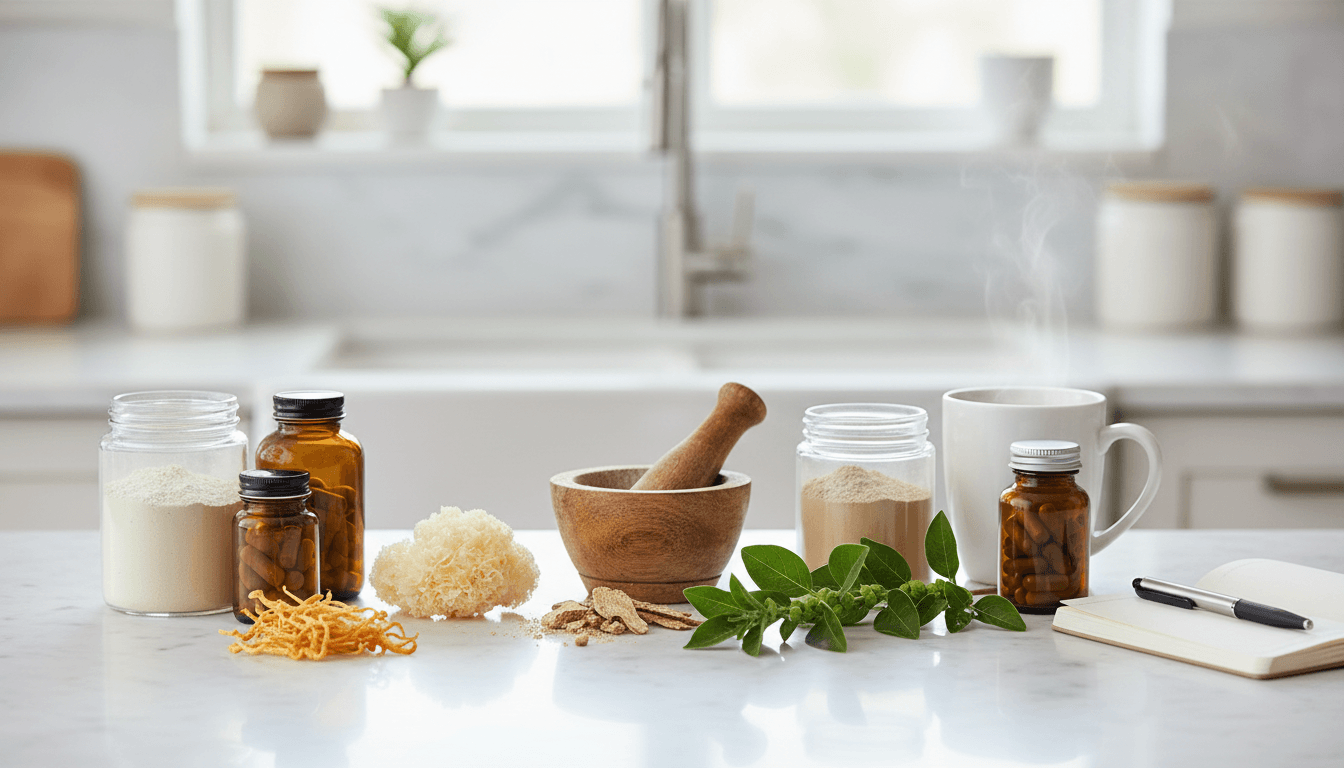
Featured Snippet: Should you take ashwagandha or mushroom supplements?
Ashwagandha is usually the better fit for cortisol-led stress, anxiety, and sleep disrupted by racing thoughts. Functional mushrooms are better matched to focus, immune balance, energy, and skin support. They are not rivals. Many people get the most complete support by pairing ashwagandha with targeted mushrooms like Reishi, Lion’s Mane, or Cordyceps.
Ashwagandha and functional mushrooms are often sold for the same goals: stress, sleep, focus, energy, and overall wellbeing.
But they do not work in the same way. Ashwagandha is best understood as a hormonal stress regulator. Functional mushrooms work across brain, immune, energy, and skin pathways, depending on the species.
This guide keeps the science, but makes the choice simpler. By the end, you should know which option fits your goal, when combining makes sense, and how to build a routine without overcomplicating it.
Ashwagandha vs Mushroom Supplements: One Paragraph
Ashwagandha and functional mushrooms are not rivals. Ashwagandha works mainly through the HPA axis and glucocorticoid receptors, helping regulate cortisol and the hormonal stress response. Functional mushrooms support different systems.
- Lion’s Mane is more focused on NGF, BDNF, and cognitive support.
- Reishi is linked with calm, sleep, and immune balance.
- Cordyceps supports cellular energy through ATP-related pathways.
- Tremella is more relevant for skin hydration and antioxidant support.
A 2025 randomised trial found that a Reishi plus ashwagandha combination significantly reduced perceived stress versus placebo. The practical takeaway is simple: use ashwagandha for hormonal stress regulation, use mushrooms for targeted brain, immune, energy, and skin support, and consider both when you want wider daily coverage.
Table of Contents
Why It Matters
Ashwagandha and functional mushrooms are often placed in the same “adaptogen” category. That can make them sound interchangeable. They are not. A clear comparison helps you choose based on your real goal: stress, sleep, focus, immune support, energy, skin support, or a balanced stack.
What Each One Actually Is
The first thing to know: you are not comparing two identical supplement types.
Ashwagandha is an Ayurvedic medicinal herb. Functional mushrooms are edible fungi with species-specific active compounds. Both can be described as adaptogens, but they support the body through different pathways.
🌿 Ayurvedic Herb · Root Extract · Adaptogen
Ashwagandha (Withania somnifera)
- Ayurvedic rasayana used for more than 3,000 years in India.
- Key compounds include withanolides, sitoindosides, and alkaloids.
- Main role: supports the HPA axis and glucocorticoid receptor signalling.
- Best known for cortisol reduction, stress support, anxiety support, sleep quality, and testosterone research.
- One of the most studied single adaptogenic herbs, with institutional guideline support.
🍄 Medicinal Fungi · Fruiting Body Extracts · Adaptogens
Functional Mushrooms
- Includes Lion’s Mane, Reishi, Cordyceps, Tremella, Turkey Tail, Chaga, and others.
- Used in Traditional Chinese Medicine and East Asian medicine for more than 2,000 years.
- Key compounds include beta-glucans, triterpenes, hericenones, and erinacines.
- Each mushroom has a different focus: cognition, sleep, immune balance, energy, or skin hydration.
- No single mushroom copies ashwagandha’s cortisol-focused mechanism.
Think of it this way: ashwagandha is one herb with a clear stress-hormone focus. “Mushroom supplements” is a whole category. Lion’s Mane for focus, Reishi for sleep and calm, Cordyceps for energy, and Tremella for skin are four different conversations.
Ashwagandha: The Hormonal Stress Regulator
Ashwagandha is most useful when stress feels like a body-wide pattern, not just a busy mind. Its main pathway is the hypothalamic-pituitary-adrenal axis, often called the HPA axis.
The HPA axis helps decide how much cortisol your body produces in response to stress. Ashwagandha’s withanolide compounds appear to interact with glucocorticoid receptors, helping turn down the sensitivity of that stress-response system.
That effect has been measured in trials. Several randomised controlled trials report serum cortisol reductions of about 27 to 32% after 60 days of supplementation at 300 to 600mg per day.
15 RCTs
Bachour et al. included 15 randomised controlled trials in a 2025 meta-analysis, finding significant reductions in cortisol, stress, and anxiety with ashwagandha.[3]
873 participants
The combined participant pool makes this one of the strongest data sets for a single adaptogenic herb.
72% sleep quality improvement
Langade et al. reported a 72% sleep quality improvement in the ashwagandha group, compared with 29% in placebo.[4]
WFSBP recognition
The World Federation of Societies of Biological Psychiatry gave ashwagandha a provisional recommendation for generalised anxiety disorder.[5]
Ashwagandha also has secondary mechanisms. Research has discussed GABA-A receptor activity, serotonin changes, NF-kB pathway inhibition, Nrf2 activation, and antioxidant effects.
Where Ashwagandha Stands Out
No functional mushroom currently has the same direct cortisol-lowering evidence. Reishi may support calm and stress resilience, but ashwagandha has the clearer cortisol-specific research. If your main issue is stress, anxiety, or sleep disruption linked to feeling wired, ashwagandha is the more direct starting point.
The Four Functional Mushrooms: What Each One Does
Functional mushrooms are easier to understand when you stop treating them as one thing. Each species has its own role.
🧠 Focus · Memory · Brain Fog
Lion’s Mane
Hericium erinaceus
Lion’s Mane is the nootropic mushroom. Its hericenones and erinacines are linked with NGF and BDNF support, making it the most relevant option here for focus, memory, brain fog, neuroplasticity, and long-term cognitive support.
😴 Sleep · Calm · Immune
Reishi
Ganoderma lucidum
Reishi is the calming and immune-focused mushroom. It is linked with GABAergic signalling, gut-brain serotonin pathways, HPA axis modulation, and neuroinflammation support.
⚡ Energy · Endurance · Fatigue
Cordyceps
Cordyceps militaris / sinensis
Cordyceps is the energy mushroom. It is associated with ATP-related pathways, oxygen utilisation, VO2max support, exercise tolerance, and anti-fatigue activity.
✨ Skin · Hydration · Antioxidant Support
Tremella
Tremella fuciformis
Tremella is the skin-support mushroom. Its polysaccharides can hold large amounts of water, and recent analysis reported naturally occurring hyaluronic acid at 87.76% of the polysaccharide extract.
Put simply: ashwagandha owns the cortisol and stress-hormone space. Lion’s Mane owns the cognitive build. Reishi owns sleep, calm, and immune balance. Cordyceps owns energy and endurance. Tremella owns skin hydration.
Mechanisms at a Glance: Ashwagandha vs Each Mushroom
This table is the clearest way to see the difference. A checkmark does not mean “better for everyone.” It means the mechanism is more directly linked to that ingredient.
| Mechanism / Benefit | 🌿 Ashwagandha | 🧠 Lion’s Mane | 😴 Reishi | ⚡ Cordyceps |
|---|---|---|---|---|
| HPA axis cortisol reduction | Primary, 27 to 32% reduction | Not established | Indirect via neuroinflammation | Minor anti-fatigue only |
| NGF / BDNF stimulation | Not primary | Primary, hericenones and erinacines | Minor | Not established |
| GABAergic calming | Secondary, withanolide activity | Not established | Primary, ganoderic acid | Not established |
| Serotonin upregulation | Confirmed RCT biomarker, Majeed 2023 | Not primary | Gut-brain pathway, Tang 2021 | Not established |
| Sleep quality evidence | 72% improvement, Langade 2021 | Indirect through stress reduction | Direct GABA and serotonin mechanisms | Not primary |
| Cognitive function / focus | Indirect, by reducing cortisol load | Primary, acute and chronic RCTs | Not primary | Via fatigue reduction |
| ATP / physical energy | Anti-catabolic only | Not established | Minor anti-fatigue support | Primary, adenosine pathway |
| Immune modulation | Mild immunostimulatory support | Beta-glucan activity | Primary, NK cells, macrophages, T-cells | Moderate evidence |
| Neuroinflammation reduction | Via NF-kB inhibition | Via Nrf2 / HO-1 pathway | Beta-glucans and triterpenes | Minor |
| Testosterone, men | Significant increases reported in RCTs | Not established | Not established | Limited evidence |
| Skin / beauty support | Not established | Not established | Anti-inflammatory support only | Not established. Tremella is the main skin mushroom. |
Clinical Evidence: The State of the Science in 2025
Here are the key trials and reviews, translated into plain English.
Ashwagandha Meta-Analysis
Bachour et al., BJPsych Open 2025: 15 randomised controlled trials and 873 participants. The review found significant reductions in cortisol, stress, and anxiety across ashwagandha studies.
Bachour G, Samir A, Haddad S, Houssaini MA, El Radad M. Effects of Ashwagandha Supplements on Cortisol, Stress, and Anxiety Levels in Adults. BJPsych Open. 2025. doi:10.1192/bjo.2025.10136. PMC12242034.
Ashwagandha Cognitive RCT
90-day dose study: Water-extracted ashwagandha at 125mg, 250mg, and 500mg per day was compared in stressed adults. It showed a dose-dependent stress effect, with 125mg per day identified as the lowest validated dose in that study.
PMC11085552 dose-response study; PMC8632422 90-day cognitive and sleep RCT.
Lion’s Mane Acute Cognition RCT
Surendran et al., Frontiers in Nutrition 2025: A double-blind, randomised, placebo-controlled trial found acute processing speed improvements within 60 minutes of a single dose in healthy younger adults.
Surendran G, et al. Front Nutr. 2025;12:1405796. PMC12018234. Docherty S, et al. Nutrients. 2023;15(22):4842. PMC10675414.
Reishi + Ashwagandha RCT
Current Developments in Nutrition, 2025: 499 healthy adults were randomised to a Reishi plus ashwagandha supplement or placebo for 6 weeks. The combination significantly improved perceived stress versus placebo.
Current Developments in Nutrition. 2025. doi:10.1016/j.cdnut.2025. S2475-2991(25)01643-9.
Cordyceps VO2max RCT
Hirsch et al., Journal of Dietary Supplements 2017: Cordyceps militaris supplementation was linked with significant increases in VO2max and ventilatory threshold after 3 weeks in recreational athletes.
Hirsch KR, et al. J Dietary Suppl. 2017. PMC5236007.
Which to Choose by Health Goal
Start with the outcome you care about most. That keeps the decision simple.
😰 Primary goal
Chronic Stress and Anxiety
Start with ashwagandha. Its HPA axis and cortisol mechanism addresses the hormonal side of stress. A common evidence-based range is 300 to 600mg per day of standardised extract for 60 to 90 days. Add Reishi when you also want sleep, calm, and neuroinflammation support.
🌫️ Primary goal
Brain Fog and Cognitive Performance
Start with Lion’s Mane. NGF and BDNF support makes it the more direct fit for brain fog and mental clarity. Add ashwagandha if stress and cortisol are part of the picture.
😴 Primary goal
Sleep Quality and Architecture
Use ashwagandha when stress blocks sleep onset. Use Reishi when sleep feels light, restless, or non-restorative. Combining both can support both sides of the sleep problem.
⚡ Primary goal
Energy and Athletic Performance
Start with Cordyceps for ATP-related energy and endurance. Add ashwagandha when fatigue is linked to stress, cortisol strain, or testosterone support goals.
🛡️ Primary goal
Immune Health
Reishi has the strongest mushroom fit here. It is linked with immune activity involving NK cells, T-cells, and macrophages. Turkey Tail may add gut-microbiome immune support. Ashwagandha contributes mild immunomodulation alongside its stress role.
✨ Primary goal
Skin Hydration and Anti-Ageing
Start with Tremella. It is the only option in this comparison with direct skin hydration relevance. Ashwagandha does not have a skin-specific mechanism in the same way.
Full Comparison Guides: Every Pairing Covered
Use these guides when you want the deeper version of one specific pairing. Each one keeps the same Antioxi approach: clear mechanisms, honest evidence, and practical routines.
Nootropic vs Adaptogen
Lion’s Mane vs Ashwagandha: Which Should You Take?
NGF and BDNF versus cortisol and the HPA axis. Best for brain fog, focus, stress, and sleep questions.
Calm vs Calm, Different Routes
Reishi vs Ashwagandha: Both Support Calm, But How?
GABA and serotonin pathways versus HPA axis and cortisol. Includes the 2025 RCT with 499 adults testing the combination.
Women’s Health Guide
Lion’s Mane for Women: Hormones, Menopause and Cognitive Health
The oestrogen-NGF connection, perimenopausal brain fog science, and the direct RCT in menopausal women.
Women’s Health Guide
Reishi for Women: Hormones, Sleep and the Perimenopause Connection
Three sleep mechanisms mapped to perimenopausal symptoms, plus the cortisol-oestrogen relationship.
Beauty Supplement Science
Tremella Mushroom vs Hyaluronic Acid: Is One Better for Skin Hydration?
The 2025 Foods study on Tremella’s hyaluronic acid content, molecular weight, and endogenous HA support.
Fatigue and Focus
Best Mushrooms for Fatigue and Focus
Lion’s Mane plus Cordyceps, the evidence-backed pair for mental clarity and physical energy.
Combining Ashwagandha and Mushroom Supplements: The Evidence
The most useful takeaway from this category is that you do not always need to choose one. Ashwagandha and mushrooms can cover different parts of the same wellbeing goal.
The 2025 Reishi plus ashwagandha RCT is the most direct evidence so far. It tested the combination in 499 healthy adults and found significant perceived stress improvement versus placebo.
Principle 1: Different Mechanisms
Ashwagandha’s withanolide-driven cortisol support does not duplicate Lion’s Mane’s NGF activity, Reishi’s GABAergic action, Cordyceps’ ATP support, or Tremella’s polysaccharide humectancy.
Principle 2: The Cortisol-Cognition Loop
Elevated cortisol can work against the brain pathways that Lion’s Mane and Reishi are trying to support. Lowering the stress load may make the whole routine feel more balanced.
Principle 3: Clinical Validation
The 2025 combination trial found significant perceived stress improvement at 6 weeks. No significant adverse events were observed in that study.
A Simple Morning and Evening Routine
Morning: Lion’s Mane for daytime cognitive clarity and NGF support. Cordyceps for energy and endurance.
Evening: Reishi for calm and sleep architecture. Ashwagandha for cortisol regulation and sleep onset.
This routine keeps energising mushrooms earlier and calming ingredients later.
Women’s Health: Why the Comparison Changes at Perimenopause
For women approaching or navigating perimenopause, the question changes slightly. Hormones, sleep, stress, and cognition become more connected.
As oestrogen declines, NGF and BDNF support may also shift. This is where Lion’s Mane becomes especially relevant, because its hericenone and erinacine compounds are linked with NGF and BDNF pathways.
At the same time, cortisol may rise as oestrogen falls. This can create the familiar “wired but tired” pattern: exhausted, anxious, and struggling to sleep. That is where ashwagandha may help support the hormonal stress side.
The perimenopausal stack argument: Lion’s Mane for cognitive and neuroplasticity support. Ashwagandha for cortisol and stress regulation. Reishi for sleep quality and immune support. This does not replace HRT or medical care, but it can be a practical supplement framework to discuss with a qualified healthcare professional.
Women’s Guide
Lion’s Mane for Women: Hormones, Menopause and Cognitive Health
The oestrogen-NGF connection, the menopausal women RCT, and honest HRT positioning.
Women’s Guide
Reishi for Women: Hormones, Sleep and the Perimenopause Connection
Three sleep mechanisms mapped to perimenopausal disruption, plus the cortisol-oestrogen interaction.
Evidence-Based Dosage and Timing Guide
These ranges reflect the clinical and practical guidance covered in this article. Always follow your product label and speak with a healthcare professional if you take medication, are pregnant, breastfeeding, or managing a health condition.
| Supplement | Clinical Dose | Duration | Timing | Key Evidence |
|---|---|---|---|---|
| 🌿 Ashwagandha | 300 to 600mg/day standardised root extract, minimum 5% withanolides | 60 to 90 days for full cortisol effects. Sleep improvements may appear within 4 to 6 weeks. | Evening, 60 to 90 minutes before bed | Chandrasekhar 2012; Bachour 2025 meta-analysis, 15 RCTs and 873 participants |
| 🧠 Lion’s Mane | 1.8 to 3g/day whole extract. Some acute effects reported within 60 minutes. | 4 to 16 weeks for full cognitive benefit. Ongoing use is common for neuroprotection goals. | Morning with food | Docherty 2023; Surendran 2025; Mori 2009 |
| 😴 Reishi | 1 to 1.5g/day for sleep focus. 1.5 to 3g/day for stress and immune support. | 4 to 6 weeks minimum. Often used as an ongoing daily practice. | Evening for sleep. Morning or split dosing for stress and immune goals. | Mitra 2024; Brain and Behavior 2026 blend RCT |
| ⚡ Cordyceps | 1 to 3g/day. 3g is commonly used for athletic performance. | 3 to 8 weeks for endurance improvements. | Morning, or before exercise when relevant. | Hirsch 2017, VO2max +4.8 mL/kg/min |
| ✨ Tremella | 1 to 2g/day for skin hydration. | 8 to 12 weeks for visible skin changes. | Morning with food. | Mineroff and Jagdeo 2023; Paterska 2025 |
| 🤝 Full combination stack | Lion’s Mane + Cordyceps in the morning. Reishi + ashwagandha in the evening. | 6+ weeks, in line with the 2025 combination RCT. | Split morning and evening. | Reishi + ashwagandha 2025 RCT, 499 adults, significant stress improvement. |
How to Choose Quality in Both Categories
Ashwagandha Quality Checklist
- Choose standardised root extract: look for KSM-66, Sensoril, Zenroot, or an equivalent extract with stated withanolides.
- Prefer root extract: most clinical trials use root extract. Some root-and-leaf formulas are acceptable, but whole-herb powder alone has weaker evidence.
- Check the dose: clinical trials commonly use 125 to 600mg per day. Avoid products that hide the milligrams per serving.
Functional Mushroom Quality Checklist
- Choose fruiting body extract: not grain-grown mycelium. Fruiting bodies are the target source for many key compounds.
- Look for dual extraction: especially for Reishi and Lion’s Mane, because water and alcohol extraction capture different active fractions.
- Ask for beta-D-glucan testing: a Certificate of Analysis from a named lab is one of the clearest quality signals.
- Prioritise organic certification: mushrooms bioaccumulate from their substrate, so clean sourcing matters.
Antioxi: The Complete Mushroom Range
Antioxi mushroom products are EU and UK Organic certified, made from dual-extracted fruiting body extracts, and cover Lion’s Mane, Reishi, Cordyceps, Tremella, and the wider 8 Mushroom Blend. Products are Eurofins-verified for beta-D-glucan content greater than or equal to 40%.
Pairing Antioxi’s mushroom range with a high-quality standardised ashwagandha supplement gives the broadest coverage across stress, sleep, focus, energy, immune support, and skin goals.
Frequently Asked Questions
Frequently Asked Questions
Ashwagandha vs mushroom supplements
Comparison Questions
What is the difference between ashwagandha and mushroom supplements?
Ashwagandha is an Ayurvedic herb that mainly supports the HPA axis, cortisol regulation, and the hormonal stress response. Functional mushrooms are a category of fungi. Each species works differently. Lion’s Mane is more cognitive, Reishi is more sleep and immune focused, Cordyceps supports energy, and Tremella is more relevant for skin hydration.
Should I take ashwagandha or Lion’s Mane for stress?
For stress as the main goal, ashwagandha has stronger cortisol-lowering evidence. Lion’s Mane may still help when stress shows up as brain fog, poor focus, or low mood. The simplest choice is ashwagandha for stress first, then Lion’s Mane if you also want cognitive support.
Can you take ashwagandha and mushroom supplements at the same time?
Yes, many people combine them because the mechanisms are different. A 2025 randomised, double-blind, placebo-controlled trial tested a Reishi and ashwagandha combination in 499 healthy adults and found significant perceived stress improvement versus placebo. Speak with a healthcare professional if you take medication or have a medical condition.
Which is better for sleep: ashwagandha or Reishi mushroom?
Ashwagandha may be better when stress and cortisol make it hard to fall asleep. Reishi may be better when sleep feels light, restless, or non-restorative. Many people pair them in the evening because they support sleep through different pathways.
What is the best mushroom to take with ashwagandha?
For stress and sleep, Reishi is the most logical pairing. For focus under stress, Lion’s Mane pairs well with ashwagandha. For fatigue and performance, Cordyceps is the best add-on. For a rounded routine, use Lion’s Mane and Cordyceps in the morning, then Reishi and ashwagandha in the evening.
References and Sources
- Current Developments in Nutrition. 2025. A Randomized, Double-Blind, Placebo-Controlled Study of a Reishi Mushroom and Ashwagandha Combination Supplement on Perceived Stress. doi:10.1016/j.cdnut.2025. S2475-2991(25)01643-9. 499 participants, 6 weeks. Significant stress improvement p less than 0.05. First RCT to test the combination. [Full text]
- Chandrasekhar K, Kapoor J, Anishetty S. Safety and Efficacy of a High-Concentration Full-Spectrum Extract of Ashwagandha Root in Reducing Stress and Anxiety. Indian J Psychol Med. 2012;34(3):255-262. PMC3573577. KSM-66, 300mg twice daily, 60 days. Cortisol reduced approximately 27.9%. [PMC]
- Bachour G, Samir A, Haddad S, Houssaini MA, El Radad M. Effects of Ashwagandha Supplements on Cortisol, Stress, and Anxiety Levels in Adults: A Systematic Review and Meta-Analysis. BJPsych Open. 2025. doi:10.1192/bjo.2025.10136. PMC12242034. 15 RCTs, 873 participants. Significant reductions in all three outcomes confirmed. [DOI]
- Langade D, Thakare V, Kanchi S, Kelgane S. Clinical evaluation of ashwagandha root extract on sleep in healthy volunteers and insomnia patients. J Ethnopharmacol. 2021;264:113276. doi:10.1016/j.jethno.2020.113276. 72% sleep quality improvement versus 29% placebo. [DOI]
- Sarris J, Ravindran A, Yatham LN, et al. Clinician guidelines for psychiatric disorders with nutraceuticals: WFSBP and CANMAT Taskforce. World J Biol Psychiatry. 2022;23:424-455. Provisional recommendation for ashwagandha in generalised anxiety disorder. [DOI]
- PMC12680924. 2025. Ashwagandha as an Adaptogenic Herb: A Comprehensive Review of Immunological and Neurological Effects. Mechanism review: HPA axis, NF-kB, Nrf2, GABAergic signalling. [PMC]
- Docherty S, Doughty FL, Smith EF. The Acute and Chronic Effects of Lion's Mane Mushroom Supplementation on Cognitive Function, Stress and Mood in Young Adults. Nutrients. 2023;15(22):4842. PMC10675414. 28-day RCT, 1.8g/day, significant stress and cognitive improvements. [PMC]
- Surendran G, et al. Acute effects of a standardised extract of Hericium erinaceus on cognition and mood in healthy younger adults. Frontiers in Nutrition. 2025;12:1405796. PMC12018234. Acute processing speed improvement within 60 minutes. [PMC]
- Frontiers in Aging Neuroscience. 2023. Brain volumetric changes in menopausal women and cognitive function. doi:10.3389/fnagi.2023.1158001. Oestrogen promotes BDNF and NGF; critical window hypothesis for neurotrophin support. [DOI]
- Chu QP, Wang LE, Cui XY, et al. Extract of Ganoderma lucidum potentiates pentobarbital-induced sleep via a GABAergic mechanism. Pharmacol Biochem Behav. 2007;86(4):693-698. PMID:17383716. Tang W, et al. Ganoderma lucidum promotes sleep through a gut microbiota-dependent and serotonin-involved pathway. Scientific Reports. 2021;11:13660. PMC8249598. [PubMed]
- Hirsch KR, Smith-Ryan AE, Roelofs EJ, Trexler ET, Mock MG. Cordyceps militaris improves tolerance to high intensity exercise after acute and chronic supplementation. J Dietary Suppl. 2017;14(1):42-53. PMC5236007. VO2max increased 4.8 mL/kg/min versus placebo. [PMC]
- Majeed M, Nagabhushanam K, Mundkur L. Standardized Ashwagandha root extract alleviates stress, anxiety, and improves quality of life. Medicine (Baltimore). 2023;102(41):e35521. PMID:37832082. Cortisol reduced, serotonin increased, CANTAB cognitive improvements confirmed. [PubMed]
- Akhgarjand C, et al. Does Ashwagandha supplementation have a beneficial effect on anxiety and stress? A systematic review and meta-analysis. Phytother Res. 2022;36(11):4115-4124. PMID:36017529. 12 RCTs, 1,002 participants. Anxiety SMD minus 1.55; stress SMD minus 1.75. [PubMed]
- Paterska M, Czerny B, Cielecka-Piontek J. Non-Animal Hyaluronic Acid from Tremella fuciformis. Foods. 2025;14(8):1362. PMC12027390. Tremella extract confirmed 87.76% HA content, MW above 2,000 kDa. [PMC]

Leave a comment
All comments are moderated before being published.
This site is protected by hCaptcha and the hCaptcha Privacy Policy and Terms of Service apply.