






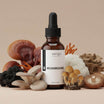






Featured Snippet: What mushroom supplements can be used for eczema?
Medicinal mushrooms such as Reishi, Chaga, and Cordyceps may support eczema management by helping regulate immune responses, calm inflammation, and strengthen skin barrier resilience. While not a cure, research suggests their beta-glucans, triterpenes, and antioxidant compounds can complement conventional eczema care when used consistently.
Medicinal mushrooms are increasingly explored as complementary support for eczema; a chronic inflammatory skin condition characterised by redness, itching, dryness, and flare cycles.
When conventional eczema treatments feel incomplete or cause unwanted side effects, many individuals look for internal immune support strategies that may address underlying inflammatory pathways.
Table of Contents
Why It Matters
Eczema impacts more than skin. Persistent itching disrupts sleep, increases stress, and worsens flare frequency. Supporting immune balance and skin barrier resilience from within may support the body’s natural inflammatory response and improve long-term comfort.
What Is Eczema?
Eczema, also known as atopic dermatitis, is a chronic inflammatory skin condition driven by genetic predisposition, immune dysregulation, and impaired skin barrier function.
This weakened barrier allows irritants and allergens to penetrate more easily, triggering redness, dryness, cracking, and itch.
Eczema Symptoms & Triggers
- Symptoms: intense itching, inflamed patches, dryness, thickened skin, flares
- Triggers: stress, allergens, harsh soaps, cold weather, ultra-processed foods
Best Mushrooms for Eczema Support
Reishi (Ganoderma lucidum)
Immune balance • Histamine modulation
Reishi contains triterpenes and beta-glucans that may help regulate immune signalling and calm histamine-related inflammation. It is often explored where allergies overlap with eczema flares.
Chaga (Inonotus obliquus)
Antioxidant defence • Barrier support
Rich in melanin and antioxidant polysaccharides, Chaga may support skin barrier integrity and reduce oxidative stress that contributes to chronic inflammation.
Cordyceps
Stress resilience • Cellular repair
Cordyceps provides adaptogenic compounds such as cordycepin that may support inflammatory regulation while assisting cellular energy and skin recovery processes.
Calm Skin Starts from Within
If eczema flare-ups are linked to immune imbalance and inflammation, supporting your body internally may help reduce intensity and frequency over time.

Explore Skin Support Mushrooms
Our lab-tested extracts are formulated to support immune regulation and resilience.
Why Mushrooms May Help Eczema
| Compound | Potential Benefit |
|---|---|
| Beta-glucans | Immune modulation and inflammation balance |
| Triterpenes | Anti-inflammatory and antihistamine activity |
| Cordycepin | Supports cellular repair and signalling |
| Melanin | Antioxidant protection for barrier integrity |
| Polysaccharides | Immune resilience and tissue support |
Dosage Guidance
Starting Range
Most mushroom extracts are taken at 1–3g daily, depending on product concentration and individual response.
Consistency
Benefits are typically evaluated after several weeks of consistent use rather than short-term dosing.
Professional Guidance
Always consult a healthcare professional if you are pregnant, managing chronic illness, or taking medication.
Choosing the Right Mushroom Supplement
Look for Fruiting Body Extracts
Fruiting body extracts generally contain higher concentrations of active beta-glucans compared to mycelium-only products.
Verify Lab Testing
Choose third-party tested products that clearly state beta-glucan content and avoid unnecessary fillers.
Avoid Unrealistic Claims
No mushroom cures eczema. Look for balanced, research-informed positioning.
Frequently Asked Questions About Mushrooms for Eczema
Choose your category
Understanding Eczema
What is eczema?
Eczema, also known as atopic dermatitis, is a chronic inflammatory skin condition characterised by itching, redness, dryness, and flare cycles. It develops due to immune imbalance, genetic factors, and weakened skin barrier function.
What causes eczema flare-ups?
Common flare triggers include stress, allergens, harsh soaps, cold weather, synthetic fabrics, and certain foods. Internal immune dysregulation increases sensitivity to these environmental triggers.
Is eczema related to allergies?
Yes. Eczema is frequently associated with allergic conditions such as hay fever and asthma. Histamine-driven immune responses can contribute to inflammation and itch intensity.
Can eczema spread to other parts of the body?
Eczema is not contagious, but scratching and ongoing exposure to triggers can cause flare areas to expand or appear in new regions.
Mushrooms & Immune Support
Can medicinal mushrooms help eczema?
Medicinal mushrooms may support eczema management by helping regulate immune signalling and inflammatory responses. Beta-glucans and triterpenes are studied for their immune-modulating properties.
What is the best mushroom for eczema?
Reishi is often explored for immune and histamine balance, Chaga for antioxidant and barrier support, and Cordyceps for stress resilience and repair. Blends are commonly used for broader immune support.
How do mushrooms reduce inflammation?
Mushrooms contain compounds such as beta-glucans that interact with immune receptors and may help modulate excessive inflammatory signalling associated with chronic skin irritation.
Are mushrooms good for psoriasis too?
Some immune-modulating compounds found in mushrooms are studied in inflammatory skin conditions like psoriasis. However, eczema and psoriasis are distinct diagnoses and require separate medical evaluation.
Can mushrooms cure eczema?
No supplement cures eczema. Mushrooms are considered complementary immune support and should not replace prescribed treatment plans.
Safety & Usage
Are medicinal mushrooms safe for eczema?
For most healthy adults, mushroom extracts are generally well tolerated when used as directed. Individuals who are pregnant, immunocompromised, or taking medication should consult a healthcare professional before use.
How long does it take to see results?
Immune-support supplements are typically evaluated over 8–12+ weeks of consistent daily use. Individual responses vary depending on lifestyle, trigger management, and severity.
What dosage of mushroom extract is used for skin support?
Common extract ranges fall between 1–3 grams daily depending on concentration and formulation. Always follow product guidelines.
Should I choose capsules or powder?
Both formats can be effective if standardised for active compounds like beta-glucans. Capsules provide convenience, while powders allow flexible dosing.
Natural Eczema Management
What else helps manage eczema naturally?
Reducing triggers, using fragrance-free skincare, improving sleep, managing stress, and following an anti-inflammatory dietary pattern may support skin barrier resilience alongside immune-focused supplements.
Can stress worsen eczema?
Yes. Stress activates inflammatory pathways and can disrupt skin barrier repair, often worsening itch and flare frequency.
Is eczema permanent?
Some children outgrow eczema, but many adults manage it long-term. Consistent trigger management and barrier support are key to reducing flare frequency.
References
- Taofiq et al. (2016). Development of Mushroom-Based Cosmeceutical Formulations. https://doi.org/10.3390/molecules21101372
- Ashraf et al. (2020). Cordycepin for Health and Wellbeing. https://doi.org/10.3390/molecules25122735
- Cör et al. (2018). Ganoderma lucidum Terpenoids and Polysaccharides Review. https://doi.org/10.3390/molecules23030649
- Boguniewicz M, Leung DYM (2011). Atopic dermatitis: a disease of altered skin barrier and immune dysregulation. https://pmc.ncbi.nlm.nih.gov/articles/PMC3122139/
- Leung DYM (2013). New insights into atopic dermatitis: role of skin barrier and immune dysregulation. https://www.jstage.jst.go.jp/article/allergolint/62/2/62_13-RAI-0564/_pdf
- Yang G et al. (2020). Skin barrier abnormalities and immune dysfunction in atopic dermatitis. https://www.mdpi.com/1422-0067/21/8/2867
- Savva M et al. (2024). Recent advancements in the atopic dermatitis mechanism. https://www.imrpress.com/journal/FBL/29/2/10.31083/j.fbl2902084/htm
- Suárez AL, Feramisco JD (2012). Psychoneuroimmunology of psychological stress and atopic dermatitis. https://pmc.ncbi.nlm.nih.gov/articles/PMC3704139/
- Cameron S et al. (2024). Mind and skin: Exploring links between inflammation and sleep disturbance in atopic dermatitis. https://onlinelibrary.wiley.com/doi/pdf/10.1111/all.15818
- Cör D et al. (2018). Ganoderma lucidum terpenoids and polysaccharides review. https://doi.org/10.3390/molecules23030649
- Zhang D et al. (2025). Intervention mechanism of Ganoderma lucidum polysaccharides in mice with atopic dermatitis. https://www.sciencedirect.com/science/article/pii/S0963996925015509
- Honjo M, Kuwabara M (2015). Useful treatment of severe atopic dermatitis with Ganoderma lucidum: A multiple-case study. http://as4qol.org/wordpress/wp-content/uploads/2015/02/mn2014001_honjo_jas4qol.pdf
- Patel S (2015). Chaga (Inonotus obliquus) mushroom: Nutraceutical assessment. https://link.springer.com/chapter/10.1007/978-3-319-12847-4_11
- Paterska M et al. (2024). Macrofungal extracts as a source of bioactive compounds for cosmetical therapy. https://www.mdpi.com/2072-6643/16/16/2810
- Ashraf SA et al. (2020). Cordycepin for health and wellbeing. https://doi.org/10.3390/molecules25122735
- Tan L et al. (2021). Anti-inflammatory effects of cordycepin: A review. https://onlinelibrary.wiley.com/doi/abs/10.1002/ptr.6890
- Kwon HK et al. (2018). Fermented Cordyceps militaris inhibits inflammatory reactions and alleviates contact dermatitis. https://www.mdpi.com/1422-0067/19/11/3504
- Das G et al. (2021). Cordyceps spp.: Immune-stimulatory and biological potentials. https://www.frontiersin.org/journals/pharmacology/articles/10.3389/fphar.2020.602364/full


Leave a comment
All comments are moderated before being published.
This site is protected by hCaptcha and the hCaptcha Privacy Policy and Terms of Service apply.